Let’s Talk Sustainability—The Marine + Vine Way

Sustainability is one of those words that has been used so much in beauty that it can be difficult to know what anyone actually means by it.
So let's be specific.
Marine + Vine makes beauty products. We source ingredients from different parts of the world, put them into packaging and ship them to people. None of that happens without an environmental footprint.
We've never thought the answer was to pretend otherwise.
What we can do is make thoughtful choices about the ingredients we use, the people we buy them from, the packaging we put them in and, perhaps most importantly, how much stuff we make in the first place.
Since starting Marine + Vine in 2019, that has been our approach: make fewer things, make them well, and keep looking for ways to do better.
Start With the Product
One of the easiest ways for beauty to become wasteful is simply to create too much of it.
There is always another launch. Another limited edition. Another product designed to solve an increasingly specific problem you may not have realized you had.
We love beauty, obviously. But we don't think you need a bathroom full of it.
Marine + Vine has always been built around a small collection of products designed to be used frequently and, ideally, finished.
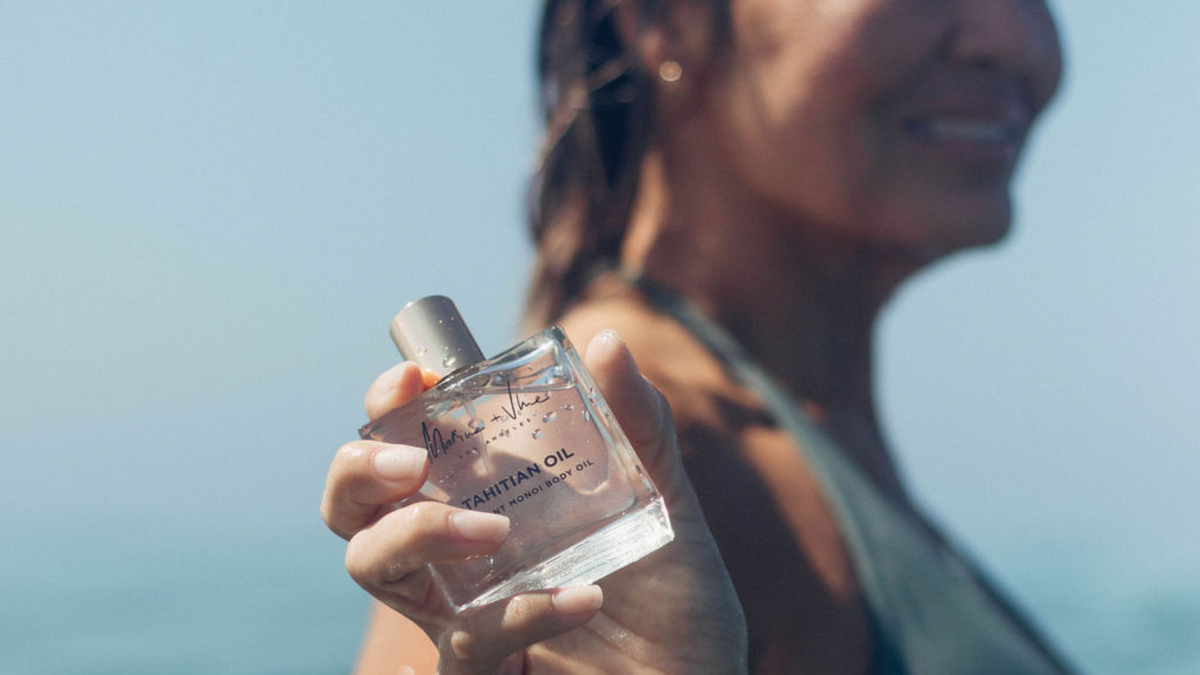
Tahitian Oil is a good example. It was deliberately created to do several jobs: body moisturizer first, but also something I use on dry hands, cuticles and the ends of my hair.
I'd rather make one bottle that earns a permanent place in your bathroom than five products you use twice and forget about.
It's not a revolutionary environmental solution.
It's just common sense.
Ingredients Have Addresses
Where an ingredient comes from matters to us.
Our hero ingredient, Monoï de Tahiti, is a particularly good example because its provenance isn't vague. Authentic Monoï de Tahiti is protected by a French appellation d'origine and must be produced in French Polynesia according to defined standards involving its coconuts, tiaré flowers and traditional production method.
There is something reassuring about an ingredient having an actual address.
We also formulate with botanical oils including macadamia, kukui and passion fruit seed oil, and we work with suppliers to understand where our raw materials come from and how they're produced.
That doesn't mean every supply chain is perfect or that we know everything there is to know about every ingredient forever. Supply chains change. Crops change. Suppliers change.
The responsibility is to keep asking questions.
Why We Use Glass
Packaging was one of the things I thought about from the beginning.
I didn't want Tahitian Oil to live in a disposable-feeling plastic bottle. Part of that was aesthetic—I wanted something substantial and beautiful enough to leave on the bathroom counter—but material choice mattered too.
So we chose glass.
Glass isn't environmentally perfect. It's heavier to ship than plastic, which matters, and no packaging material comes without tradeoffs.
But it is durable, widely recyclable where appropriate facilities exist, and it gives the product the permanence I wanted it to have.
I also think there is a behavioral side to sustainability that gets overlooked.
When something feels disposable, we tend to treat it that way. When an object feels considered, we're more inclined to use it completely, repurpose it or recycle it properly.
A beautiful bottle isn't going to save the planet.
But I'd still rather make one you don't immediately want to throw away.
Small Batches Are Actually Small
Marine + Vine is an independent brand, and one advantage of being small is that we don't need to manufacture enormous quantities of product simply to keep a global machine moving.
We can produce more deliberately.
That matters because excess inventory is one of beauty's less glamorous problems. Products have shelf lives. Packaging becomes obsolete. Trends move on. What doesn't sell eventually has to go somewhere.
Making in smaller quantities isn't always the cheapest or easiest way to operate, but for us it makes sense.
I'd rather replenish something people actually want than manufacture thousands of units in anticipation of demand that may never arrive.

Sustainability Is Also About What You Don't Make
This may be the least exciting sustainability strategy in beauty, which is probably why it doesn't get talked about enough.
Don't make unnecessary things.
We don't need to turn every ingredient into its own product. We don't need a different moisturizer for Monday morning and Thursday night. And Marine + Vine doesn't need to launch something every month simply to have something new to talk about.
Newness is fun. I love it as much as anyone.
But usefulness is a better reason to make something.
That idea influences how we think about new products. Does it do something genuinely different? Will someone actually finish it? Does it belong in the Marine + Vine world five years from now, or are we responding to a trend that will disappear by next summer?
Not every idea survives those questions.
That's probably a good thing.
What “Ecoluxe” Means to Us
We've used the word ecoluxe to describe Marine + Vine since the early days.
For me, it has never meant choosing sustainability instead of beauty.
I don't think people should have to choose.
I want a product to feel wonderful on the skin. I want the fragrance to be beautiful. I want the bottle to look good next to your perfume. I also want us to think carefully about the materials, ingredients and quantities involved in making it.
Luxury and responsibility aren't opposites.
But neither should “luxury” become an excuse for excessive packaging, and “sustainable” shouldn't mean putting a beige label on something and calling the job done.
We're Not Finished
This is probably the most important part.
I don't believe sustainability is a certification you award yourself and then stop thinking about.
Materials improve. Packaging technology changes. Better suppliers become available. Sometimes a decision you thought was the more responsible one turns out to involve a tradeoff you hadn't fully considered.
Being a small company means we can't solve every part of the beauty industry's environmental footprint ourselves.
It also means we can change things without asking permission from twelve departments.
So we'll keep looking at the formula, the bottle, the box, the way we ship and the amount we produce. When there is a genuinely better option that makes sense for Marine + Vine, I want us to take it.
And when something isn't perfect, I'd rather tell you that than find a prettier word for it.
Fewer, Better Things
Ultimately, my idea of sustainable beauty is fairly simple.
Buy fewer things. Choose the ones you really love. Use them.
Finish the bottle.
Recycle what you can.
And expect the companies you buy from—including ours—to keep doing better.
That's the version of sustainability we're interested in.