Article: Passionate About Passion Fruit Oil
Passionate About Passion Fruit Oil
Passionate About Passion Fruit Oil
Passion fruit is one of those ingredients that sounds as though it was invented by someone in beauty marketing. The name is almost too good.
But behind the tropical fruit and admittedly romantic name is an oil we've loved since we first started formulating Tahitian Oil.
Also known as maracuja oil, particularly in Brazil, passion fruit seed oil is pressed from the tiny seeds inside the fruit. It's naturally rich in essential fatty acids, particularly linoleic acid, but what first makes you notice it isn't the chemistry.
It's the texture.
Passion fruit oil is remarkably light. It spreads beautifully, absorbs easily and leaves skin soft without the heaviness people sometimes associate with botanical oils.
That combination is exactly why we use it.
What Is Passion Fruit Oil?
Passion fruit oil is extracted from the seeds of Passiflora edulis, the passion fruit most of us recognize from markets, juices and the occasional caipirinha.
Cut open the fruit and you'll find an intensely fragrant pulp filled with small black seeds. Those seeds contain an oil with a very different personality from the lush fruit surrounding them.
Depending on its origin and processing, passion fruit seed oil is typically composed largely of linoleic acid, an essential omega-6 fatty acid, along with oleic, palmitic and smaller amounts of other fatty acids.
It is sometimes called maracuja oil—maracujá being the Portuguese word for passion fruit—so if you've seen both names on beauty products, they're generally referring to oil derived from passion fruit seeds.
Why Is Passion Fruit Oil Good for Skin?
The appeal of passion fruit oil comes largely from its fatty-acid composition.
Our skin barrier contains lipids that help keep moisture in and the outside world out. When skin becomes dry or compromised, supporting that lipid layer with a well-formulated emollient can help it feel softer, smoother and more comfortable.
Passion fruit seed oil does this without feeling particularly rich.
That's important.
An ingredient can have a wonderful nutritional profile on paper, but if you don't enjoy putting it on your skin, none of that matters very much.
It's rich in linoleic acid
Linoleic acid is an essential fatty acid, meaning our bodies need it but cannot make it themselves.
It's also an important component of healthy skin-barrier lipids. Passion fruit seed oil is naturally high in linoleic acid, which is one reason it has become increasingly interesting in skincare.
For dry skin, fatty acids help condition and soften the surface. But because passion fruit oil feels lighter than many richer botanical oils, it can provide that conditioning effect without leaving behind an overly oily finish.
It's light enough for people who don't think they like body oil
I hear this all the time: I don't like oils. They're too greasy.
Fair enough. Some are.
But “oil” describes an enormous category of ingredients, and they don't all behave the same way on skin.
Passion fruit seed oil has a light, fluid texture and absorbs relatively quickly. In a blend, it can help create the kind of body oil you can apply after a morning shower and then actually get dressed.
No waiting around the bathroom. No oil marks on everything you own.
This was important to us when we made Tahitian Oil because I wanted something I'd use every day, not only when I had twenty leisurely minutes before bed.
Passion Fruit Oil for Dry Skin
If your skin is dry, the instinct is often to reach for the thickest cream you can find.
Sometimes that's exactly what you need.
But richness isn't the only measure of how useful a moisturizer will be. Oils rich in fatty acids can soften dry skin and help reduce moisture loss, particularly when they're applied at the right time.
With passion fruit oil—or any body oil—the best time is just after a shower, while your skin is still slightly damp.
The water gives your skin hydration. The oil helps hold onto it.
This is especially useful on legs, arms and shoulders, where dryness has a tendency to return approximately five minutes after you've congratulated yourself for moisturizing.
What About Passion Fruit Oil for Mature Skin?
You'll often see passion fruit oil recommended for mature skin, usually because of its fatty acids and naturally occurring antioxidant compounds.
We think there's a more straightforward reason to like it.
Skin often becomes drier with age, and oils can be an excellent way to supplement the skin's surface lipids and improve softness and suppleness. Passion fruit oil does that while remaining relatively light.
It isn't going to erase a wrinkle—and we wouldn't tell you that it will.
But well-moisturized skin tends to look smoother, healthier and more luminous than dry skin. Sometimes the least exciting explanation is also the most useful one.
Is Passion Fruit Oil Good for Hair?
Passion fruit seed oil also turns up in hair products, particularly those designed for dry or damaged lengths.
Its lightweight texture makes it appealing when you want some conditioning without making hair look oily.
If you're using Tahitian Oil, you don't need a separate technique. After applying it to your body, run whatever is left on your palms lightly over the ends of your hair.
The operative word here is lightly.
We're going for polished ends, not an accidental wet look.
Maracuja Oil vs. Passion Fruit Oil
For the most part, these names refer to the same botanical source.
Maracujá is simply the Portuguese word for passion fruit, and the term became particularly familiar in beauty because of the fruit's association with Brazil.
What matters more than the name on the front of the bottle is what's actually inside it: the botanical species, how the oil was extracted, how it was processed and what else has been added to the formula.
“Maracuja” may sound slightly more exotic.
Passion fruit seed oil is what it is.
And it's very good.
Why We Use Passion Fruit Oil in Tahitian Oil
One of the things I've come to appreciate about formulating with oils is that you can't judge a blend by looking at each ingredient in isolation.
They have to work together.
Monoï de Tahiti gives Tahitian Oil its rich, emollient foundation and much of its sense of place. Macadamia oil brings conditioning fatty acids and a beautiful silkiness. Kukui oil is light and nourishing.
Passion fruit seed oil helps balance them.
It gives the blend a lighter, more fluid quality—the difference between an oil that feels wonderful in theory and one you actually want to smooth over your entire body after every shower.
And that, ultimately, is the point.
How to Use Passion Fruit Oil
You can use pure passion fruit seed oil on its own, but we prefer it as part of a balanced blend.
With Tahitian Oil, step out of the shower and lightly pat yourself dry, leaving some moisture on your skin. Warm the oil between your palms and massage it over your body.
Use a little more on dry areas and a little less when it's hot or humid. Whatever remains can go over your cuticles or through the ends of your hair.
It's not complicated, and it shouldn't be.
One of the Less Famous Oils in the Bottle
Passion fruit has a glamorous name. Strangely, its seed oil tends to be one of the ingredients people know least about in Tahitian Oil.
Monoi gets the romance. Macadamia gets the omega-7 story. Passion fruit quietly gets on with making the formula better.
Maybe that's why I like it so much.
It is light where other oils can be heavy, useful without requiring a lot of explanation and exceptionally good at making skin feel soft.
Sometimes that's all you need from an ingredient.
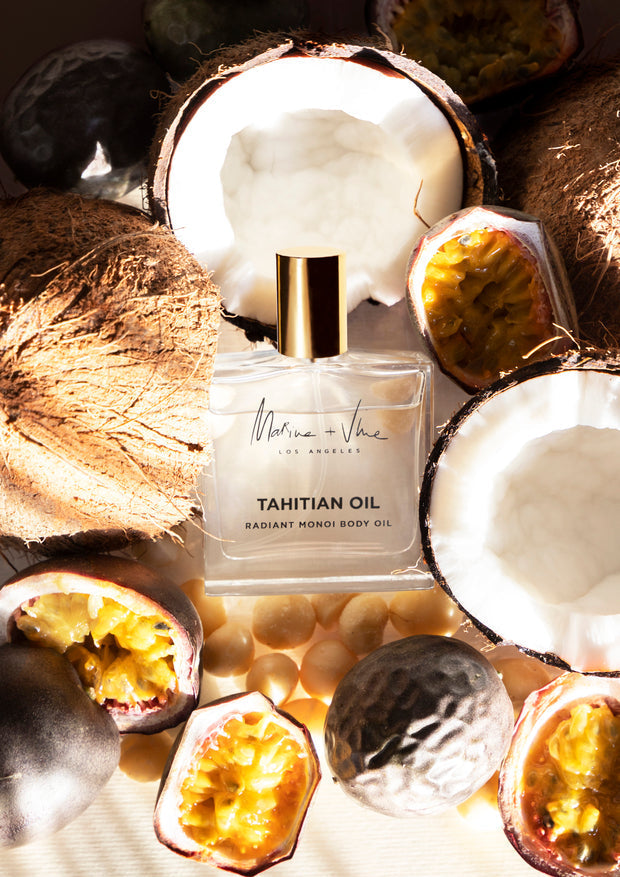
Discover Marine + Vine Tahitian Oil, our blend of Monoï de Tahiti, macadamia, kukui and passion fruit seed oils, created for soft, moisturized skin without the heavy finish.

